
From Overwhelmed Player to Raid Leader
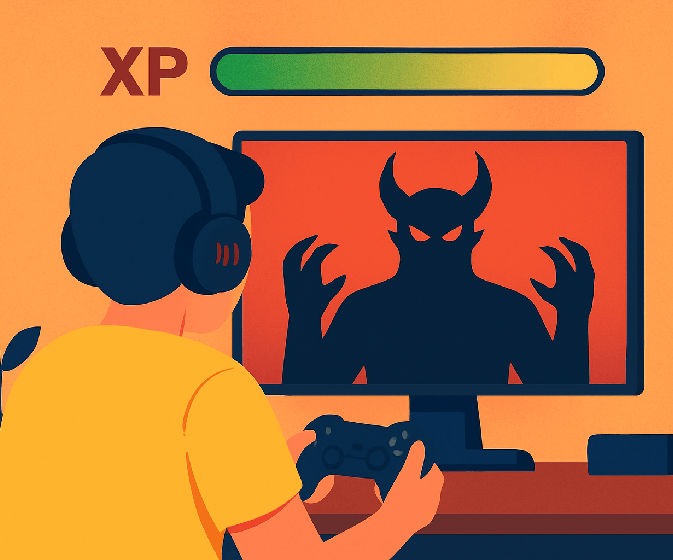
You know that feeling when a massive task drops on your plate? It looms over you like a final boss—a work project with a tight deadline, a semester-long assignment, or the dreaded quest of reorganizing your entire apartment. The sheer scale of it is overwhelming. You don’t know where to start, so you stall, grind low-level side quests (like scrolling social media), or just log out mentally. This is called procrastination, and it’s a direct response to feeling overwhelmed.
But here’s the thing: as a gamer, you’ve already trained for this. You’ve beaten raid bosses with dozens of mechanics, solved complex puzzles, and pushed through wipe after wipe until you achieved victory. The skills you use to succeed in games—strategy, preparation, persistence, and teamwork—are the exact same skills needed to conquer big real-life challenges.
Welcome to the “Boss Fight” mindset — a scientifically-backed framework to reframe daunting tasks into strategic, winnable battles using the power of gamification.
Step 1: Identify the Boss (Define the Big Task)
Every raid begins with knowing your opponent. You don’t just wander into a dungeon; you scout, you name the boss, and you understand what you’re up against. An undefined threat is infinitely more intimidating than a known enemy.
- Before: “I need to do that huge work project.” (Vague, stressful, infinite)
- After: “My mission is to defeat ‘The Q3 Report Behemoth’.” (Specific, named, beatable)
The Science Behind It: Escaping the Zeigarnik Effect
This isn’t just a mental trick; it’s a cognitive necessity. Our brains are wired to fixate on incomplete or undefined tasks, a phenomenon known as the Zeigarnik effect. This mental obsession drains your focus and energy. By clearly defining and naming your “boss,” you signal to your brain that you have a concrete plan, which reduces anxiety and frees up mental bandwidth.
Step 2: Break the Fight into Phases (Chunk the Work)
No raid boss is defeated in a single, massive blow. They have health bars, distinct phases, and new mechanics that unlock over time. Your big task is the same. Trying to tackle it all at once is a guaranteed recipe for a mental wipe. Instead, break it down into smaller, sequential stages.
For “The Thesis Dragon,” the phases might be:
- Phase 1 (100%-75% HP): The Research Phase. Gather all sources and outline the main arguments.
- Phase 2 (75%-25% HP): The Drafting Phase. Write the first full draft, ignoring perfection.
- Phase 3 (25%-0% HP): The Polish Phase. Edit, format citations, and submit.
The Science Behind It: Avoiding Cognitive Overload
This process, known as task decomposition or “chunking,” is crucial for managing cognitive load. Your brain’s working memory can only handle a few pieces of information at once. A massive, unbroken task overloads this system, leading to shutdown and procrastination. Breaking it into 3-5 distinct phases turns an overwhelming wall of text into a clear, manageable quest log.
Step 3: Gear Check (Prepare Your Tools and Environment)
Nobody charges into a raid without repairing their armor, stocking up on potions, and equipping their best loadout. Preparation is what separates a successful run from a frustrating failure. In life, preparing your environment and tools is just as critical.
- Optimize Your UI: Clean your workspace. A cluttered desk is full of visual distractions that constantly pull your focus, reducing your mental DPS.
- Gather Your Consumables: Get all your resources ready before you start. Open the right tabs, find the necessary files, and have a glass of water ready.
- Set Your Keybinds: Prepare your tools for success. Use a task manager, set a timer, or put on a focus playlist.
The Science Behind It: Reducing Friction
This is about designing your environment for success. Every small obstacle—like having to find a password or clear a space on your desk—is a point of “friction.” According to habit-formation research, even minor friction can be enough to make you abandon a task. By preparing everything beforehand, you create a frictionless path to starting, making it easier to “pull the boss.”
Step 4: Call in Your Party (Get Support and Accountability)
Most raid bosses aren’t meant to be soloed. They require a balanced party of tanks, healers, and DPS. The same goes for life’s biggest challenges.
- Find Your Tank: A mentor or coach who can absorb some of the initial “damage” by giving you advice and guidance.
- Recruit Your Healer: A supportive friend or family member who can boost your morale when you’re feeling drained.
- Team up with DPS: An accountability partner or study buddy who is working alongside you, helping to push through the phases.
The Science Behind It: The Power of Social Accountability
Research from The Association for Talent Development (ATD) shows that you have a 65% chance of completing a goal if you commit to someone. And if you have a specific accountability appointment with that person, your chance of success rises to 95%. Announcing your “raid time” to your party makes you far more likely to show up and perform.
Step 5: Master the Mechanics (Work Smart, Not Just Hard)
Mindlessly spamming your abilities doesn’t win raids. Success comes from learning the boss’s mechanics, anticipating attacks, and executing the right strategy at the right time.
- Use Work/Rest Cycles: Your brain, like your character, needs to manage its resources. Use a proven method like the Pomodoro Technique:
- Work with intense focus for 25 minutes (a “DPS burn phase”).
- Take a 5-minute break (a “regen phase”).
- After four cycles, take a longer 15-30 minute break.
- Anticipate Interruptions: What are the “adds” that will spawn during your fight? A noisy roommate? Phone notifications? Plan ahead by turning off your phone or communicating your focus time to others.
The Science Behind It: Focused Work and Strategic Breaks
The Pomodoro Technique works because it creates a sense of urgency (a short deadline) while preventing burnout. The scheduled breaks are not lazy; they are essential for cognitive function. They allow your brain to rest its prefrontal cortex (responsible for focus) and consolidate information.
Step 6: Collect the Loot (Celebrate Wins Along the Way)
Why do we grind raids for hours? The loot. The achievement pop-up. The satisfaction of progress. These rewards are crucial for motivation. Build the same reward system into your real-life boss fights.
- After completing Phase 1, reward yourself with a 30-minute gaming session.
- After finishing your daily quest, enjoy your favorite snack or watch an episode of a show.
The Science Behind It: Hacking Your Dopamine Loop
When you complete a task and receive a reward, your brain releases dopamine, a neurotransmitter associated with pleasure and motivation. This creates a powerful feedback loop: Action -> Reward -> Good Feeling. This loop reinforces the behavior, making you more likely to tackle the next phase. These small celebrations are not frivolous; they are a neurological necessity for maintaining long-term motivation.
Think Like a Raider, Execute Like a Pro
Big tasks don’t have to feel like overwhelming, impossible walls. When you gamify them with the Boss Fight mindset, you transform chaos into structure, anxiety into strategy, and procrastination into motivation.
Every raid boss you’ve ever faced seemed unbeatable at first—until you pulled, learned the mechanics, wiped a few times, and pushed through for the win. Life’s biggest challenges work the exact same way. They are not insurmountable; they are a series of mechanics waiting to be learned.
So next time a massive task looms, don’t think: “Ugh, this is impossible.”
Think: “Time to pull. I’ve got this.”
Leave a Reply